Solar Roof Technology: Modern Energy Solutions for Homeowners
Outline:
– Introduction: Why solar roofs matter for homeowners.
– Technology overview and performance: BIPV shingles, roof-integrated panels, inverters, and orientation.
– Costs, incentives, financing, and ROI with a simple payback illustration.
– Design, installation, and weather resilience; permitting and interconnection.
– Maintenance, warranties, sustainability, and a homeowner decision framework (conclusion).
Introduction: Why Solar Roofs Matter Now
Electricity has become the quiet backbone of modern homes, fueling everything from heat pumps to induction cooktops and electric vehicles. As households lean more heavily on the grid, energy bills and reliability take center stage. Solar roof technology—where photovoltaic materials are built into or seamlessly integrated with roofing—offers a sturdy path to produce power right where it’s needed. Unlike rack-mounted panels that sit above shingles, many solar roof systems blend into the roofline, pairing curb appeal with steady output. They operate without noise, require little attention, and can turn an idle surface into a productive asset.
What gives solar roofs their rising relevance is a convergence of factors: higher retail electricity rates in many regions, improving solar cell performance, better weather resistance, and smarter hardware that simplifies operation. For homeowners considering a re-roof, the timing can be particularly favorable. Installing building-integrated photovoltaics (BIPV) during a roof replacement can consolidate labor and materials, mitigating some of the premium that comes with integrated products. Beyond personal economics, solar roofs expand local resilience by distributing generation across neighborhoods, reducing stress on transformers during hot afternoons and giving households options during outages when paired with batteries.
Typical homes consume between roughly 7,000 and 12,000 kilowatt-hours (kWh) per year, and a properly sized system can offset a significant share of that usage. Well-designed arrays are matched to a property’s sunlight, roof geometry, and electrical needs, ensuring efficient production without oversizing. Equally important, modern solar roof components coordinate with time-of-use rates, exporting surplus power when it’s valuable and charging a battery when that benefits the household. The result is a roof that does more than keep out rain; it actively manages sunlight, time, and money.
Common homeowner motivations include:
– Reducing long-term energy costs with predictable production
– Improving aesthetic harmony by integrating power generation into the roof itself
– Increasing resilience when combined with storage and smart controls
– Supporting local decarbonization without sacrificing daily comfort
How Solar Roofs Work: Materials, Efficiency, and Real-World Performance
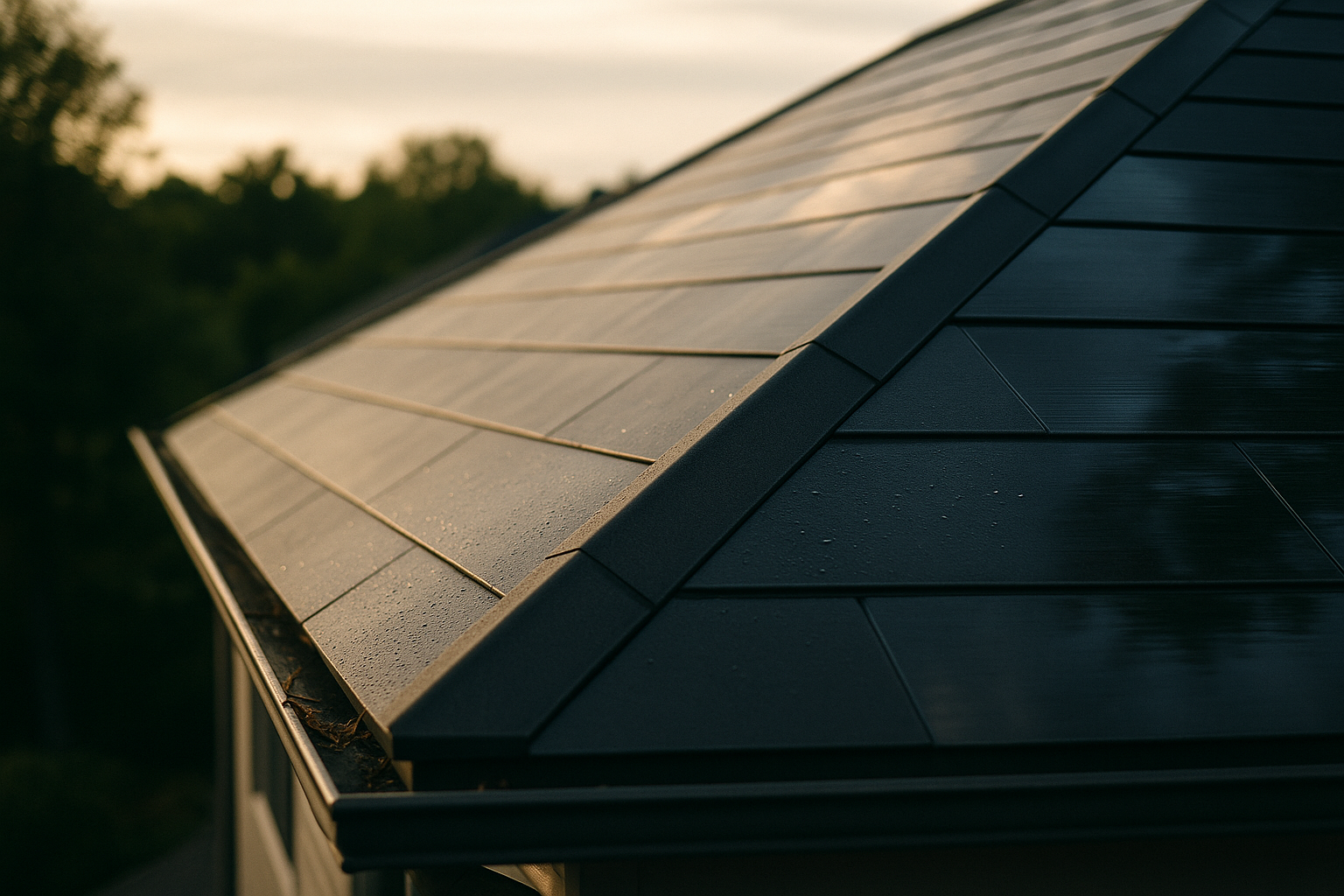
Solar roofs come in two main flavors. First are BIPV shingles or tiles that replace traditional roofing materials while generating electricity. Second are roof-integrated panel systems that sit flush with the roof deck, framed and flashed to look cohesive. Both approaches harness the same principle: semiconductor cells convert sunlight into direct current (DC), which inverters turn into alternating current (AC) for home circuits and the grid. The visual profile differs, but the core physics is shared.
Efficiency and heat management are central. Many solar shingles trade a bit of efficiency for aesthetics and integration, typically landing in ranges that are slightly lower than high-performing framed modules. Real-world performance also depends on how well the system sheds heat; hotter cells produce less power, with temperature coefficients often around -0.3% to -0.5% per degree Celsius above test conditions. Ventilation gaps, dark shingle colors, and roof pitch all influence operating temperature. While efficiency percentages can help compare options, annual energy yield is what ultimately pays the bills.
Orientation, tilt, and shading shape that yield. South-facing roofs in the northern hemisphere (and north-facing in the southern hemisphere) generally produce more, but east- and west-facing arrays can align nicely with morning and evening demand. In many locations, each kilowatt (kW) of solar can generate roughly 1,000 to 1,800 kWh per year, depending on latitude, weather patterns, tilt, and shading from trees or neighboring buildings. Microinverters or power optimizers can limit the impact of partial shading by allowing each module or tile to operate closer to its potential rather than being dragged down by a shaded neighbor in a simple series string.
Integration brings added benefits beyond looks. BIPV shingles often serve double duty as roofing and generator, with underlayments and flashing systems engineered for water management. Roof-integrated panel systems use specialized frames and trim to create a flush surface that sheds water and snow. Both are designed to work with standard roofing practices so that qualified installers can deliver a finished, weather-tight system. The net effect is a roof that maintains its familiar function while introducing a quiet, reliable source of electricity on sunny, hazy, and even lightly overcast days.
Key performance considerations for homeowners:
– Local solar resource: seasonal sun hours and weather variability
– Roof geometry: pitch, orientation, and obstructions like chimneys and skylights
– Thermal behavior: ventilation, color, and materials that affect operating temperature
– Electrical design: inverter choice and circuit layout for safety and uptime
Costs, Incentives, and Payback: Turning Sunlight into Cash Flow
The price of a solar roof varies with product type, roof complexity, local labor rates, and whether you are replacing the roof anyway. In many markets, rack-mounted panels remain the most economical per watt, while integrated shingles typically command a premium for their aesthetics and dual-function role. Before incentives, integrated solutions can land in the mid-to-upper range of residential solar pricing, particularly on complex roofs with multiple planes or dormers. When the numbers are evaluated over decades, many homeowners find that the premium narrows once roofing and energy savings are considered together.
Common cost drivers include:
– Roof replacement scope: full tear-off vs. partial, underlayment upgrades, and flashing
– Array size and complexity: number of circuits, inverters, and monitoring hardware
– Electrical upgrades: service panel capacity, wiring runs, and code-required equipment
– Soft costs: design, permits, inspections, and interconnection fees
Incentives can be pivotal. Many regions offer tax credits, rebates, low-interest loans, or performance-based payments. Some areas support net metering or export rates that credit excess generation, while others use time-of-use structures that reward afternoon and evening power. Because policies change, it’s smart to get current figures from local agencies and reputable installers, and to confirm whether incentives apply to integrated roofing materials, storage, or both.
Here is a simplified illustration, not a quote. Imagine a 7 kW solar roof priced at $4.50 per watt installed, totaling $31,500. Suppose available incentives reduce upfront cost by 30%, bringing the net to $22,050. In a region where a 7 kW system produces about 9,800 kWh per year and electricity averages $0.20 per kWh, the first-year bill reduction could approach $1,960. Ignoring minor maintenance and modest annual degradation (often around 0.5% to 0.8%), a rough simple payback falls near 11 years. Time-of-use savings, export compensation, and battery strategies can shift the outcome meaningfully, as can roof complexity and labor markets.
Financing options range from cash purchases to secured or unsecured loans, and in some locales, property-assessed financing may be available. Ownership typically delivers stronger long-term value than third-party leases because homeowners capture incentives and resale benefits directly. Appraisals in multiple markets have documented value premiums for owned systems, though the magnitude varies and clear documentation of system size, age, and performance helps during a sale. When stacked against rising energy costs, a durable roof that steadily offsets consumption can be a compelling addition to a household balance sheet.
Design, Installation, and Resilience: Building It Right
A solar roof is a roof first, so water management and structural integrity come before anything electrical. Installers start with a structural assessment to confirm the roof can handle added loads—often in the range of 2 to 5 pounds per square foot for many residential systems, including hardware. They check sheathing condition, rafter spacing, and connections to evaluate deflection limits and safety margins. From there, underlayments, flashing, and edge details are planned to direct water away from penetrations and seams, preserving a continuous waterproof layer beneath integrated components.
Safety and code compliance guide the electrical design. Inverters and disconnects are placed for accessibility and clear labeling. Conductors are routed to minimize voltage drop and exposure, with protection from abrasion and UV. Rapid shutdown capabilities, ground-fault protection, and arc-fault detection are now standard in many jurisdictions. Where batteries are included, installers consider ventilation, clearances, and fire code requirements, locating equipment where ambient temperatures and access work in the system’s favor.
Resilience is baked into both roofing and electrical components. Many integrated systems carry high wind ratings, robust uplift resistance, and impact ratings that align with hail-prone regions. Fire classifications often reach Class A when installed over approved assemblies. In snowy climates, installers account for sliding snow loads and safe egress paths, and in coastal areas they prioritize corrosion-resistant fasteners and coatings. In hot, arid regions, thermal expansion and heat shedding get extra attention to maintain output and preserve materials over decades.
Permitting and interconnection are part of the journey. Expect plan reviews, inspections, and a utility approval before energizing. Lead times vary with local workloads and seasonality, so plan for several weeks to a few months from contract to activation. Transparent schedules and checklists keep surprises at bay.
Questions to ask prospective installers:
– How will water management be handled at edges, valleys, and penetrations?
– What structural assumptions underpin the load calculations for my roof?
– Which inverter architecture will you use, and why is it appropriate for my shading?
– What are the wind, impact, and fire ratings for the specific assembly?
– How are service access and part replacements handled over time?
– What is the expected production profile by month, and what assumptions drive it?
Conclusion: A Practical Path to a Solar Roof
Owning a solar roof is less about chasing records and more about steady, long-term performance with minimal fuss. Day to day, maintenance is light: keep an eye on the monitoring app, schedule an occasional visual check from the ground, and rinse dust or pollen if accumulation is visible and safe access is available. Most systems are designed to withstand the elements without routine intervention, and annual or biannual inspections by a qualified professional can spot issues early—loose fittings, sealant fatigue, or animal nesting. Snow generally slides as temperatures rise, and hail resilience is addressed by impact-rated materials; if a severe storm hits, document conditions and contact your installer and insurer for guidance.
Warranties usually come in layers: product coverage for materials and workmanship, and performance guarantees for power output over time. It is common to see output warranties spanning two decades or more, with a defined allowable degradation curve. Inverters often have separate terms, and batteries carry their own cycle-based or year-based coverage. Keeping purchase agreements, specification sheets, and serial numbers organized will help if service is ever needed.
From a sustainability standpoint, integrated solar roofs help cut operational emissions immediately by displacing grid electricity with low-carbon generation. Lifecycle analyses of photovoltaic technologies typically show emissions in the range of a few dozen grams of CO2-equivalent per kWh—substantially lower than fossil-based generation—while energy payback times are measured in a handful of years depending on location and manufacturing source. At end of life, recycling pathways for glass, aluminum, and silicon are expanding, and choosing products with published take-back or recycling plans adds confidence.
Use this simple decision framework:
– Roof timing: if replacement is due within a few years, integration may consolidate costs
– Sunlight: confirm shading analysis and seasonal production estimates
– Budget: compare net cost after incentives, including roofing scope, to expected savings
– Resilience: decide whether storage is worthwhile for your outage profile
– Aesthetics: weigh the value of a low-profile look versus a higher-efficiency rack system
– Installer fit: select a well-regarded team with clear documentation and support
For homeowners who value quiet reliability, bill control, and design harmony, a solar roof can be a thoughtful upgrade that pays its way over time. Start with a reputable site assessment, compare integrated and non-integrated proposals on equal terms, and choose the pathway that aligns with your home’s timing and your household goals. With careful planning, the same shingles sheltering your family can also power the life unfolding beneath them.